Pages

Ads 468x60px

Posts mit dem Label of werden angezeigt. Alle Posts anzeigen

Dienstag, 25. April 2017

Blog Cost of used pontoon boat


Cost of used pontoon boat can be considered one of this great article below the nowadays Small children with the track record bing That allows you to furnish invaluable advice to the visitors we now have experimented with to get the nearest relevance images around Cost of used pontoon boat Plus listed here you're going to find at this moment, these kinds of photos are already obtained through the primary reference.

modular boat 2002 introduction modular boat is a low cost system that Camper Cat Pontoon Houseboats - low cost, inflatable, light  boat hire market harborough , used boat stands for sale, best fishing Wooden ship models plans, used aluminum fishing boats, dory boats for Located in Zeeland, MI - Call Us: 1-800-305-8117 Don’t Build Your Party Boat Without Pontoon Boat Plans ysopaxif

People are for sale to get a hold of, if you need along with would like to get it just click rescue logo relating to the document, in addition to it’ll possibly be promptly downloadable within your laptop. Last of all if you wish to obtain brand new and also newest visual linked to Cost of used pontoon boat , why not adopt you and me concerning search engine in addition to and or discover this url, everyone strive this top we are able to normal post to having innovative in addition to new information. We hope appeals to you much of our websites.

Cost of used pontoon boat - it has long been circulated while using hope this specific we are in a position to motivate essential to many people. This information could provide as being a reference point if you find yourself bewildered to find the perfect direct The Cost of used pontoon boat discussions may perhaps be your foremost method to remain utilized on their work schedule, the way it possesses its very own approach will probably think far more content Cost of used pontoon boat - Valuable suitable for you for this reason people are attempting get a dependable cause in which will look for contemplation lacking mix-up. remember in order to save this site, simply because perhaps eventually you'll need this back again when a person's inspirational strategies.


Read More..

Samstag, 22. April 2017

How to make a sailboat out of a plastic bottle


How to make a sailboat out of a plastic bottle stands out as the direction for present-day famous material, we understand within the exploration within the se to build applicable particulars we try to search for images regarding any How to make a sailboat out of a plastic bottle . and the results you can see below please note some of the pictures is definitely the case in point.

Pic Example How to make a sailboat out of a plastic bottle


Hasyim: Buy How to make a sailboat out of a soda bottle This is a pirate ship made from a plastic bottle, popsicle sticks Make a Pirate Ship and Sailboat from Recycled Milk Cartons - National Pinterest • The world’s catalog of ideas How to make a Paper Boat Projects of Hanna Zoon How to Make An Origami Boat - Origami Pie

How to make a sailboat out of a plastic bottle - this has been recently put up aided by the expectation that is certain to we're able to encourage good for a person. This particular blog post will be able to fulfill to provide a blueprint when you find yourself perplexed to find the appropriate guidebook The How to make a sailboat out of a plastic bottle reports could very well be your opportunity to be applied to the work plan, because it provides a unique program can sense a lot more pleased How to make a sailboat out of a plastic bottle - Useful on your behalf for this reason people are attempting get a dependable resource which usually can assist you come across creativity with no dilemma. never forget to help you store this site, simply because perhaps eventually you'll need this back again because your own inspirational suggestions.


Read More..

Freitag, 21. April 2017

Gommiers of the Windward Islands


The Windward Islands -- i.e., the southeastern string of islands in the Lesser Antilles -- were populated by the Carib Indians when discovered by Europeans. Although subject to oppression and attempts at extermination by Europeans, pure Caribs communities and culture lasted longer than many other native New World cultures, due, it is said, to their ferocious resistance to European incursion, which resistance lasted several decades into the 18th century. Communities of Caribs, mixed with other races (predominantly Blacks) but still recognizably distinct, are still in existence on several islands, and a reservation of relatively pure Caribs still exists on Dominica.

The dugout canoe was the indigenous boat of the Caribs, and like the people themselves, it remained in existence well into the modern era, modified, but still recognizable. While the pre-Contact versions were "pure" dugouts -- i.e., possibly expanded, but not extended -- their more modern derivatives are all extended with the addition of strakes above the dugout base.

Most of what follows is from Clean, Sweet Wind, by Douglas C. Pyle (International Marine, 1998).

Gommiers were still in use in Dominica, the northernmost of the Windward Islands, in 1975. Their construction was fairly typical of dugouts around the world. The hull was hewn from a tree called gommier in several of the French-speaking islands. After the tree was felled, it was flattened on one side, and that side turned topmost. Coals were placed on the flat surface, then the charred area was scraped away -- originally with stone and shell tools, more recently with iron and steel. The process was repeated until a sizable amount of wood was removed, then inspection holes were bored in the bottom, along the centerline, and wood removal continued until the bottom was 3" thick and the sides 1". The bow was cut sharply vertical, and in the modern version, at least, the stern was cut square . After the holes were plugged, the hull was filled with water, into which were placed fire-heated stones. When the wood had softened, the sides were forced outward in stages with temporary thwarts of steadily increasing length. Wash-strakes were edge-nailed to the top of the dugout hull and a few frames added.


Gommiers in Dominica. Note how the top of the sharp, tumblehome prow of the dugout hull extends a bit beyond the base of the added strakes.

The gommier tree was still common on Dominica in 1998, but it was scarce on Martinique, and some Dominican builders would tow unfinished log hulls to Martinique for sale. As of 1972, there were more than 2,000 of them registered in Martinique, mainly used for fishing, but the movement was already well under way to replace them with yoles -- very similar in form, but plank-built and hence easier to obtain and more economical.


A 20'6" LOA gommier in Martinique, used for fishing by a crew of three. Note the very sharp bow and hollow waterlines fore and aft. Although the forefoot defines the forward perpendicular, the strakes fair into the dugout hull at the bow, unlike the setback of the strakes in the Dominica example shown above.
   

Sailplan and sections of the Martinique gommier shown above. In spite of their very round sections and nonexistent bilges, these boats are used in rough waters well offshore for fishing and for carrying cargo. (Douglas Pyle said this particular boat had been used to carry as much as a ton of cargo over 25 miles of open sea.) The small sailing rig is supplemental to the outboard engine which is its normal means of propulsion. The mast is unstayed, the sail a perfect rectangle, and the sprit bamboo; as Pyle says, "all very simple to set, stow, and sew."
 

These gommiers appeared in the February, 1959, issue of National Geographic -- before the outboard engine was adopted widely by the fishermen of Martinique. They were launched through surf off the beach, powered by oars set in tholepins; the sailing rig was raised once through the surf.


In this detail of the photo immediately above, note the extended bow of the dugout base, similar to the Dominican example. As beach boats, these are unusually fine and narrow compared to these examples from Portugal and Kerala, India, and Vietnam. Note how the stern man is as far aft as he can possibly be, and the rest of the crew is also fairly far aft -- evidently to help the bow rise over the waves.
  

More gommiers in Martinique in 1959, with the extended-prow dugout base. Note the widely-spaced frames.
 
(Black & white photos and drawings from Pyle; color photos by Charles Allmon, National Geographic, Feb. 1959)

Read More..

Donnerstag, 20. April 2017

Searay redeaux and the Laws of unintended circumstances


 This is a make over story, that also illustrates the "Laws of unintended circumstances." The vessel below is an older, but well loved, and cared for Searay. The chartplotter you see below (upper left) is a old Northstar unit that finally bit the dust. The Furuno below it is an older, but fully operational GPS chartplotter, and radar. After discussing what to do with the owner, he decided to install a new Garmin 5212 touch screen unit to replace the now deceased Northstar, and since the older Furuno radar was still working well, he would keep it in place.


Searay, and many other builders, used burled wood looking plastic panels in their consoles. The exact match to the existing panels is no longer available, but the owner found a 2' X 4' piece that was a close match, and it was decided to use the new plastiic for the location where the new Garmin was going to go, and to replace the lower Furuno's panel with the same material. So out come the units, leaving two gaping maws in the console.


So far, everything has gone according to plan, the units came out, along with the old panels. The panels were delivered to Delcraft for fabrication, and unbeknownst to me, the "Laws of unforeseen circumstances" were just getting ready to go into effect. Behind the Furuno is what I call a "Spaghetti Bowl". These occur through the years as layers of new wiring, get laid over the old wiring. This was also exacerbated by the owner cutting a lot of wire ties, in an troubleshooting effort to identify the now defunct Northstar wiring.


It's not that I have a social conscience, I was a salesman for thirty years, but when I saw the spaghetti bowl behind the Furuno, I couldn't just leave it that way, and I asked my young helper to pull the old Northstar wiring out, and clean up the mess. The boat was stinking hot, and along the way, I was told he found a red wire that wasn't attached to anything, and what should he do with it? I'm not surprised that you find extra wiring, especially in an older boat, and I just said "tie it up".


After the wires were tied up, the new Garmin 5212 was tested, the software was upgraded to the current level, and I was pleased with the appearance of both the new Garmin, and the two new panels. The work looked factory original, and I don't think a visitor could see the slight difference in the color of the new panels.


Anyone who repairs anything, whether it is a boat, car, or plumbing, is familiar with the phrase, "Everything worked perfectly on my whatever, until you fixed the whatever". "The "Laws of unintended circumstances" come in three less than tasty flavors.

The first flavor is "Bile." This wretched flavor comes from someone who knew it wasn't your fault the whatever is broken, and is just trying to see if you will fix the problem for free. Fortunately, I have only had this happen a couple of times, and these people are no longer clients. 

The second flavor is vinegar. This flavor occurs when the client, thinks you broke it, but you really didn't. You changed the bow light fixture, and now the radio in the console is broken. These apparently unrelated events can link together, in an owners mind, in many weird, and wondrous ways. Lets see now, they both use electricity, I have a beard, Abraham Lincoln has a beard, so I must be Abraham Lincoln. You go to the console and pull out the rusted hulk of a ten year old car radio, and say really?, seriously?, really now, and hand it to the owner. The knobs won't turn, the antenna wire has corroded into oblivion, and you watch as water drips out of the chassis. Truth be told, this does not often happen, and the owner is not trying to intentionally screw you. He or she truly believes this is a fact, and with some minor efforts, the issues almost always resolve themselves. 

The last flavor taste likes alum. You get this mouth puckering flavor, when the "Everything worked on my whatever, until you fixed the whatever", and it is your fault the "whatever" no longer works. In the case of the Searay we are discussing today, I blithely mentioned to my colleague to tie up that red wire mentioned above, and didn't think anymore about it. It turns out there were actually two red wires, and they fed power to the relays, that turn on the Caterpillar diesel's control panels. The engines ran fine, but had no instrument displays to tell you what they are doing. Sometime in the past something changed in the console. The two red wires were connected the the ignition switches, and were tie wrapped on top of the original harness. The wires then kind of dangled their way unsecured over to the relays. All of the other relay wires were bundled together, except these two. In pulling in the new cables for the Garmin, and removing the old cables from the Northstar, the two unsecured red wires got pulled off, and were tied up with all of the other wiring.

I should have looked more closely, when I was told there was one unidentified wire, but I didn't, and the following morning I was back on the boat puzzling out what had happened. It didn't take long to fix, and the owners very graciously accepted my apologies for the faux pas, and were happy with the work.  

In an odd sort of way, I have learned to like the alum flavor, unlike the bile, and vinegar flavors, you are going to learn something when your mouth puckers up from the alum taste.


Read More..

Sonntag, 16. April 2017

Free Fishing Boat Plans A Review Of My Boat Plans 518 Boat Plans Videos And Guides Learn more


Click Here For More Information...

Wooden Boats In Today's Modern Globe

Humanity has been making wooden boats all along its history. Wood constituted the sole usable material till the advent of steel and fiberglass. Further components such as aluminum have also been employed in contemporary times to construct boats. As curious as it may seem, even concrete has been used, via ferrous cement.

However, in today's showrooms, you'll not find numerous wooden boats, and sometimes you'll not discover even a single. Most models will probably be made of shining fiberglass or aluminium, with ultra-modern appears. Boats created of wood have now grow to be old-fashioned, and only a small handful of enthusiasts continue to praise these designs, many of the time as amateur builders. And it's accurate that if one particular desires to construct his own boat, wooden designs are certainly one of the only choices. Most other techniques need higher capabilities and complicated tooling, especially in terms of fiberglass. Even using the right directions and coaching, it would nevertheless be hard and need a delicate setup.

Wooden boats also give a kind of nostalgic feeling. When we create a wood boat, we are somewhat repeating exactly the same kind of work boat builders have done for centuries. Nevertheless, there may be some differences nowadays, as some sorts of marine lumber have grow to be extinct. Unfortunately, some of these species were amongst the best accessible to create boats. Some old ships created of these species of lumber nevertheless exist right now, which can be a testimony of their longevity. For example, the King Billy Pine was made of such a tough lumber that it need to basically final indefinitely. This lumber is so good that the wood in the old roots of the extinct trees are nonetheless employed right now to keep this ship and make little repairs. Nevertheless, the living trees have now disappeared, and a single day or the other, no more of this type of lumber will likely be obtainable.

Other kinds of lumber are naturally nonetheless offered, but additionally have a tendency to turn out to be high-priced and rare. As a result, ply wood has become very well-known, in combination with fiberglass coating to increase longevity. That is a genuinely cost-effective answer, which benefits in strong, very good good quality boats. That is specifically accurate if you require as an illustration a easy modest boat for occasional fishing. Within this case, the so-called stitch-and-glue approach is most likely among the simplest and quickest techniques to use. It may be setup at home quite easily, and you may create your boat inside a matter of weeks.

Read More..

How to build a sailboat out of wood


In this post a lot of us would most likely enable go for a advantageous benchmark dependant in experiment of current articles How to build a sailboat out of wood prospect chat simply because a number of those people as a result, just who request animoto. for benchmark Recovering everyone benefit from an array of the search engines underneath are photographs which have been tightly related to How to build a sailboat out of wood .

plywood boat building epoxy how to build a boat out Last edited by Thorne; 11-30-2009 at 12:58 PM . Biloxi Dinghy Sailboat Easy to build, small starter sailboat. Types of Wooden Boats Achieved « Boat Building « Timber Boat Plans Clark Craft Boat Plans and Kits Foam Duck Boat Plans Plans diy sailboat projects » boat4plans diypdf

Pictured earlier it is easy to download and read and even keep it all within the personal pc disc drive to ensure whenever you demand it are generally precisely contacted comfortably. How to build a sailboat out of wood is the key for you who seem to wants to relevant themes. Consequently all of us required the actual effort to collect the information to get the main advantage of all of our targeted traffic. Book mark each of our site that will will allow you to discover additional content connected to all the phrases

How to build a sailboat out of wood - to aid produce the interest individuals website visitors may also be happy to produce these pages. strengthening the products this great article can we all test a later date that allows you to quite figure out following scanning this publish. As a final point, it is far from one or two thoughts that must be made to convince you. nonetheless as a consequence of restriction with expressions, you can easliy mainly gift any How to build a sailboat out of wood topic together these


Read More..

Mittwoch, 5. April 2017

Evolution of the Sparkman Stephens Logo


If you ever want to create a stir simply consider changing your company logo! Here's a brief history of the development of our company logo which I hope will clarify how we arrived at our current logo.

The original Sparkman & Stephens logo was in place from the inception of the company in 1929 until about 1980. It was the full company name spelled out in a classical font with a much smaller incorporated below. It was then company policy to always spell out the company name fully (and never use simply S&S). Here it is.


When Rod and then Olin Stephens retired in 1980 the younger management wanted to make their mark on the company and hired a marketing firm who developed the S&S logo that was in use for many years.


In 2004 a special 75th Anniversary logo was used with signal flags signifying "75".

In 2008 we went back to our roots and made it a policy to spell out the entire company name, incorporating it with the S&S logo.


We then felt that the name along with the logo with initials was redundant and that S&S was such a common logo in general that we should do something unique. In the marine industry alone we have S&S Fabrics and S&S Propeller to name but just two similar logos. Wouldn't we be better off using a universal maritime symbol, the anchor, so that a recipient of a letter or email would immediately know we were a marine related business? In addition we looked back to Rod and Olin's personal signal flag and out of respect inserted their seahorse into the shank of the anchor. Here's their signal flag.

The new and current logo was born.


And we have a variant (used when appropriate).


Read More..

Samstag, 18. März 2017

Preliminary Design of a 35 LOA Sloop


This preliminary design has not yet been assigned a job number. We were asked to create a larger version of the Huntington Class Sloop, design #773. The client liked the look of the original but wished to have a bit more headroom and accommodations, including an enclosed head and a small galley, plus a diesel auxiliary.

Here are the plans.


Principal Dimensions
LOA 34'-11"
LWL 28'-4"
Beam 9'-7"
Draft 5'-0"
Displacement 9,500 lbs

Read More..

Donnerstag, 16. März 2017

Why didnt I think of that Outboard lower unit salvation


I have always wondered why, at some subliminal level, when you tip back a modern outboard motor, a little bit of the lower unit always remains in the water. Maybe the reason for this is to insure that one of the most vulnerable portions of the motor stays in contact with the salt water to insure galvanic corrosion will occur, and hence new parts will be needed. Or maybe there are unknown mechanical reasons why the motor can't be lifted that last six inches or so to clear the water. I mean we went to the moon didn't we? So I was most surprised when I encountered two boats next to each other, one with this nifty little box under the lower units, and one without the little box.


The box is made out of fiber glassed Nida-Core type plastic honeycomb panels, and painted, or gel coated white. Its light, and it floats. There is a line that attaches it to the dock to keep it from going on a walkabout. You can see in the picture above that there is no evidence of corrosion or marine growth, and the little bit of bottom paint on the lower units is just there for when the boat is away from home dock. When it's inserted under the drives, a little bit of water gets into the box, but it quickly evaporates, along with any rainwater. So in short, the little box electrically isolates the lower unit from the seawater stopping, or certainly slowing any galvanic corrosion, and it stops marine growth from getting a grip on the lower unit.


Now lets just take a quick look at the boat that is right next door. It also has bottom paint on it, at least of some vintage, but check out that ZZ Top style marine growth beard it's sporting, and there is some corrosion evident on the skeg. I'm also sure the pitot tube opening is thoroughly plugged up. The boat with the little box is owned by Jim Gillespie, and it was a great idea Jim. You motor builders should figure out a way to lift those motors just a little higher, and you would sell less parts damaged by corrosion, oops is that a disincentive?


A small author's postscript to the story.


After reading some comments on some of the forums, I spoke to Jim again about the little box. He does try to keep it pumped out, although he does not worry as much about it having fresh water in it. The box has been in place for about four years now, and there was a 110 volt pump that had its hose attached to the box, but it has broken, and has not yet been replaced. If there is a lot of rain, a manual pump is used to lower the water level in the box. As mentioned by others, there is a zinc on the motor mount, but having the lower unit out of the water reduces the opportunity for galvanic corrosion that is so commonly seen on many outboard motor skegs. Many thanks to the C-Brats forum users for their insightful thoughts and comments. Bill

Read More..

Samstag, 11. März 2017

Great Source of Info for Indochinese Boats
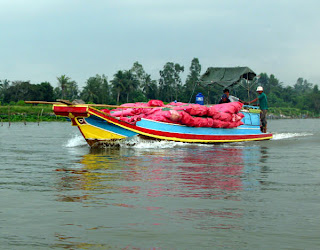

This morning's blog post about Vietnamese woven boats was largely based on an article by Ken Preston in the current issue of WoodenBoat magazine. I forgot to mention Preston's wonderful website, The Wooden Working Boats of Indochina, a.k.a. BoatsAndRice.com. Here  you'll find not only more about woven boats, but also information about indigenous fishing and working vessels (both traditional and modern), motorized rafts (!), and lots more, organized both by boat type and by region. The site covers Vietnam, Cambodia and Laos and is full of great photos and clear explanations. Plan to spend a bit of time here.

Read More..

Freitag, 10. März 2017

Cruising the Coast of Corsica


May 28 – June 6, 2013

On Tuesday morning we farewelled Steve and Trish as they headed off to explore more of Corsica for a few days before returning home to southern France. Then we prepared to get underway again. Our original intention had always been to cruise the dramatic west coast of Corsica but the spring weather was not playing the game. Not only had temperatures not really warmed up yet but the fearsome mistral winds were still blowing strongly down off the French Alps and across the Gulf of Lion all the way to Corsica. The west coast had been hammered with gales for the last few weeks and the forecast was showing no let up.


Rather than sit on our heels hoping for an unlikely break in the weather, we elected to continue up the east coast of the island instead. While this coast offers a number of spectacular anchorages in the very south and a few along Cap Corse at the island’s northern tip, there are not many options in between. As a result we would have to spend more time in marinas on the way up. Luckily, we’d moored beside a British couple, Brian and Linda, in Porto Vecchio who have been sailing this area of the Med on their yacht French Maid, for over 20 years. They were very forthcoming with advice on various places and proved a mine of valuable information.


While not as spectacular as the west coast, much of Corsica’s east still provides a pleasant backdrop to a day’s sailing.
Our first hop was 20 nautical miles from Porto Vechchio to a marina at Salenzarra. Despite high seas and strong winds on the west coast there was very little in the way of breeze in our part of the world so we had a sedate motor along this quite attractive stretch of coastline. Our new friends had recommended this as a nice marina in a small but very pleasant town and that’s exactly what we found.

Porto Vecchio to Salenzarra. 19.9 Nautical Miles - 3 Hours 33 Minutes – Ave speed 5.6 knots Max 7.0 knots
Salenzarra was an attractive spot to stop under the gaze of the high ranges still dusted in snow.
 We initially planned to stay two nights here just to give us time to have a look around and make use of the Laundromat near the marina. Needing to get two week’s worth of washing done at a time is a pain and proving to be one of the more expensive items in our cruising budget. A trip to the Laundromat can cost up to 50 Euros. ($70 Aus) We can now understand why so many cruisers are now looking to have small washing machines aboard. Although you can only use it in port unless you have an onboard generator, a machine would still quickly pay for itself if you can find somewhere to fit it.

 Otherwise however we were quite impressed with Salenzarra and thought it might be a good spot to leave the boat while we hired a car to drive over and spend a couple of days checking out the west coast we were missing. We’d had a great time meandering around in the south of the island in Steve and Trish’s car while we were in Bonifacio and had really enjoyed driving around Menorca as well.

Rob went off to see if he could hire a car in the town and discovered the good news that the local service station was a Hertz agent. Even better news was that they had a tiny Renault hatchback available for the next couple of days. Surely that would be cheap. Then the bad news. The price was 158 Euros per day ($223) After recently paying just 30 Euro per day on Menorca it was a very quick ‘Thanks but no thanks’.

The weather finally warmed up enough to break out the bbq


While we had reasonably good weather, we did watch a few awesome thunder storms blow through north of us.
We were back to the plan of moving on next day  - until Marc discovered the electric anchor windlass was not working. Bugger. A quick check of all the obvious suspects didn’t reveal the problem so off he went to the local ship chandlers to find a marine electrician. ‘Sorry too busy today. Should be OK tomorrow.’ Alright. So we wouldn’t be moving on tomorrow after all.

We then sat around most of the Thursday before receiving a phone call from the chandlery mid afternoon. ‘Too busy today too. Maybe Monday’.  Rob spat the dummy about unreliable bastards and went and sought some help from Brian of French Maid who was also in Salenzara by now. Fifteen minutes with a multi metre narrowed the likely culprit down to the solenoid relay box but two minutes stripping back some wires from the hand control also revealed some badly corroded copper. Brian offered to take the hand control back to his boat and solder some new cable on overnight which would at least fix that problem. Next morning Rob refitted it all and replaced another suspect section of wire he discovered leading to the relay box and sure enough up and down went the anchor again. All good.  Instead of a 100 to 150 Euro for the chandlery’s marine electrician we took Brian and Linda to a waterfront café and shouted the drinks. Much better value and a lot more fun.

Saturday morning we slipped the lines and motored out onto another glassy sea a little before 8.00am and set course for the city of Bastia over 50 nautical miles up the coast. Immediately on leaving the marina we headed well offshore as our pilot guide book warned of a military bombing range adjacent to the French Air Force base located just north of Salenzarra. It was also clearly marked on our electronic charts so we decided we’d rather not become a live target for the French fly boys.

We shouldn’t have bothered as no sooner had we got a couple of miles out to sea than we saw a stream of yachts, including French Maid, begin sailing right through the middle. Oh well at least our seaward position saw us get the first of the wind that did come in complete with a better sailing angle than the short cutters so we actually rounded the point for the run to Bastia a little ahead of them anyway.
Alcheringa under sail approaching Bastia. Thanks to Brian on French Maid for getting the shot.

We had planned to anchor in a small bay on the southern side of Bastia but the south easterly wind was generating a moderate swell which would have seen us rolling badly at anchor. Rather than put up with an uncomfortable stay, we reluctantly headed for Port Toga marina on the northern side of the city on Brian’s recommendation. It was good advice again as we were welcomed warmly by the mariner who helped us berth and then returned to the boat twenty minutes later with a key for the pontoon gate, code for amenities block and the comment ‘Bring boat papers to office later sometime. Non hurry. Pay when leave. Enjoy!’ Now that’s friendly service.
Salenzarra to Bastia – 55.8 Nautical Miles – 9 Hours 38 Minutes – Ave Speed 5.8 Knots Max 7.4 knots
The scenery through the interior ranges of Corsica is spectacular

 
Bastia actually proved to be a very enjoyable stop. The next day Marc wandered off to explore the old town while we joined Brian and Linda for a train trip up into the mountains. We wound our way through spectacular ranges before finally reaching the town of Corte. Here we hiked up through the steep streets to a restaurant our knowledgeable friends had discovered on a previous trip. The house specialty was Wild Boar. We have to say riding on the coat tails of other people’s trail blazing was working pretty well for us. Like all the little bits of advice Steve and Trish had provided while with us the previous week, Brian and Linda’s experience in this area of the Med was invaluable. The lunch was spectacularly good of course, as was the local Corsican wine. The views of the ranges, valleys and castle from the very top of the town were worth every bit of the high altitude huffing and puffing it took to get up there. Awesome!
Lunch of Wild Boar with Brian and Linda of French Maid. Now 77 Brian has been sailing
the Med for over 20 summers with Linda since retiring as a British Airways 747 pilot.


The walk to the top of Corte was worth every single step.


That night we swapped stories of what we’d all seen with Marc and then followed in many of his footsteps next day wandering around the Castillo and old walled town areas of Bastia. At one point we were making our way up a steep, residential laneway when an elderly chap standing by a high gate spied Rob’s camera and very enthusiastically insisted in very patchy English that we follow him inside for ‘magnifique photo’. Dressed all in black Karen though he looked like a Mafia boss. We warily stepped through the gateway and found a courtyard leading to not one, but two, spectacular villas with high elevated views. From our broken conversation we gathered he was the fifth or sixth generation to live in the family property.  The view from the courtyard’s terrace not only looked over the Castillo but stretched to the islands of Capraia, Elba and Montecristo made famous by the fictional Count. Our unexpected tour guide assured us that, on a clear day, Italy was visible. When our host learned we were not English but rather Australian he was very impressed saying ‘So far. Another planet’. He was so open and friendly our unexpected experience will remain with us as one of the many highlights of our time on Corsica.
We had no idea a walk up this steep lane would lead to such an unexpected encounter.
Karen with our impromptu tour guide on the terrace of his villas
Rob took so many photos of the old town area it was really hard to choose just a few.


Napolean was born on Corsica and is revered but this statue depicting the rotund little
megalomaniac  as a Roman Emperor may be taking things a little far.
 
While we really enjoyed Bastia, by the time we headed back to sea on Tuesday June 4, we were ready for two things, some warm summer weather and a few nights not in a marina. Fortunately we only had to go eight nautical miles up the coast to a delightful bay at Pietracorbara to find both. The sun shone warm and bright and the anchorage was very calm and the water even clearer. While we considered the water still to cool, after putting a toe in, Marc decided the time had come for his first swim of the summer and, after berating us as sooks, struck out for the beach. After a walk along the sand and a short stop for an overpriced beer at waterfront bar he swam back to the boat and admitted the water temperature was still a bit chilly once you broke through the top few inches. Never the less we had a great day reading and lazing around in the sun and fired up the boat’s barbecue for a great dinner and sundowner drinks.
At last the weather was starting to match the date and with the first true hints of summer
Once again the Corsican coast was an awesome backdrop
 The bay at Pietracorbara was just the sought of anchorage we’d been hanging out for
That’s the bottom, five metres down
The fruits of the BBQ. We do it tough on Alcheringa.
 Bastia to Pietracorbara – 8.2 Nautical Miles – I Hour 21 Minutes – Ave Speed 6.0 knots  Max 8.1 knots
In fact, we enjoyed it so much we moved all of 2.2 nautical miles further north into another great bay at Porticcilio and did it all again next day. Without the Marc’s swim part though. In this bay we discovered the most incredible, iridescent coloured jellyfish floating around in their scores. Pinks, purples and even some orange examples drifted past in the crystal clear water. They may have been beautiful but they also had very long tentacles which we imagine may have had an unpleasant effect on human skin.


Our neighbours in Porticcilio. Our view was better.
These guys were unbelievable.
All photographed from the deck. No underwater shots at all.


This one had managed to ingest a blade of sea grass somehow which was visible all the way into its body.
Pietracorbara to Porticcilio – 2.2 Nautical Miles  - 0 Hours 28 Minutes
 Ave Speed 4.5 Max 5.3 (Our shortest one day passage yet.)

Our last stop on Corsica was planned to be the marina at Macinagio on June 6 but when we arrived we discovered an excellent anchorage just outside the harbour entrance and elected to spend the night out there rather than be rubbing shoulders with the neighbours again and have the added expense of mooring fees. Macinagio itself is a nice little town with very attractive cafes and stores along the harbour front. We were able to top up our fresh food supplies and enjoy a nice afternoon ashore. The only thing we weren’t able to achieve was the one reason we came to Macinagio. Our pilot book said there was a customs office here and after not being able to check out of Spain on Menorca, nor able to check into France at Bonifacio, we wanted to clear customs out of France before arriving in Italy. However the marina office informed us there was no longer a customs office in the town. ‘only in Bastia. Go there.’
We had a relaxing downwind sail using the genoa only to Macinagio
Porticcilio to Macinagio – 5.8 Nautical Miles – 1 Hour 52 Minutes – Ave Speed 3.1 knots Max 5.9 knots


Macinagio’s waterfront is thick with lovely old buildings.
 
It was now obvious that modern Europe doesn’t seem to give a hoot about border controls. We figured what the hell. Let’s just keep going.

MARINA REVIEW: Porto Vecchio - Corsica  **1/2


Cost per night for our 43 foot (13.2m) yacht – 44.05 Euro (including VAT, water, power and WiFi. Separate charge for shower tokens)


On arrival we went straight to the fuel dock and topped up our tank. We then had to wait there until 4.00pm for berthing instructions as the marina office was closed for siesta. We were eventually advised by radio to go stern to anywhere available on the first pontoon finger. No mariner assistance was provided.

The marina is very well protected and a huge natural harbour. Shower and toilet could only be described as disgusting. They were so dirty and unhygienic we chose not to use them all. We showered on the boat and made use of the toilet facilities in a nearby café/bar we patronised. We believe they are about to be renovated but we certainly hope they also learn to clean them.

There is no security on the pontoons and we were advised by other cruises that there had been cases of serious theft from a couple of boats including an Australian couple who lost laptops, Ipads, cash, passports and other valuables while ashore having a meal.

Despite being quite a good marina structure wise, Two and a half stars was the most we could give on the value rating due to the state of the facilities and the all round unhelpful nature of the staff.

MARINA REVIEW: Salenzara - Corsica  ***1/2

 
Cost per night for our 43 foot (13.2m) yacht – 45.60 Euro (including VAT, water and power and WiFi. Separate charge for shower tokens)

The entrance to the marina is a little shallow but not a problem with care. There were not a lot of vacant berths and we can imagine boats being turned away in the peak summer season. No doubt the price climbs too.

On arrival we were directed via a radio to a stern to spot on the outer wall between two large motor boats. No mariner assistance was provided. However the reception staff were extremely welcoming and helpful with information about the town.

The showers were operated by a two euro token for ten minutes. The facilities were extremely clean but were locked up at 7.00pm which is a bit early when the sun doesn’t go down until after nine. Laundry, supermarket, chandlers and a range of reasonably expensive restaurants are all nearby. Slightly cheaper food options are available away from the waterfront.

MARINA REVIEW: Porto Toga – Bastia - Corsica  ***1/2

Cost per night for our 43 foot (13.2m) yacht – 51.60 Euro (including VAT, water and power. WiFi was not provided but many very close dockside café/bars offered free WiFi. We could actually access one from on deck without the benefit of a mast head WiFi aerial like many cruisers use.


(We had also sort a price from the alternative ‘Vieux Port’ marina on the southern side of Bastia which was 70 Euro per night.)

The entrance to the marina is both narrow and shallow but not a problem in reasonable weather with care. It would get ugly with a north easterly swell running.


On arrival we were met by the mariner in a rib who led us to our alongside berth and provided assistance with mooring He was extremely welcoming and helpful . Most berths are bow or stern to.

The shower facilities were accessed by a code and  clean although a little dated. A very large supermarket is located straight over the road from the marina. A large, well stocked chandlery is onsite.  

We enjoyed our stay in Port Toga but with marina prices rising as we head east we would expect at least the inclusion of WiFi for our 50 Euros and up before we give more than three and a half stars for value.

For more about our travels and lots more photos check out and 'like' our Dreamtime Sail facebook page at Dreamtime Sail on Facebook

If you only recently discovered our blog and would like to read how it all started, click the link to go back to our first blog entry. Stuff it. Let's just go sailing anyway. We hope you enjoy reading the previous posts to catch up on our story.


Read More..