Posts mit dem Label Class werden angezeigt. Alle Posts anzeigen
Posts mit dem Label Class werden angezeigt. Alle Posts anzeigen
Sonntag, 23. April 2017
Local boats I like 2 the Classy A Class Cat
My first thought was the boat is on the trailer upside down, but the trampoline is on top. What is this boat? Like all shiny things I had to take a closer look. The other thing was the name on the boat, "Armington." I knew that name, but I had never seen it associated with a sailboat.
This is an "A Class" racing catamaran with a wave piercing bow designed by naval architect O. H. Rodgers who also provided the tooling. According to the IACA (International A Cat Assoc.) these are the "fastest single handed racing boats in the world." A Class racing catamarans are a "Box Rules" developmental sailboat. The basic configuration is simple. The boats must weigh at least 165 lbs (75kg) (which this one weighs), have a maximum length of 18' (5.49m), and width of 7.5' (2.3m). The sail area can't exceed 150 sq ft (13.94 sq m).
Like all things in life, the details of the rules impose some additional restrictions. Other than that, have at the design, and materials you make it out of. For the time being there are no hydrofoils allowed yet but some forms of lifting structures appear possible by modifying the rudders.
Like all things in life, the details of the rules impose some additional restrictions. Other than that, have at the design, and materials you make it out of. For the time being there are no hydrofoils allowed yet but some forms of lifting structures appear possible by modifying the rudders.

This is one of two nearly identical boats built by Sam Armington, and Jeremy Herrin with some technical help from their boat building dads. The dad's provided maybe a bit, or more likely a lot of their sweat also. Gary Armington was founder of Talon power boats, and Felix Herrin was Catman Cats, a builder of large custom power catamarans, Both provided the experience needed to build these custom composite vessels.

These two boats were not a casual build project. It took a year to build the twin crafts, and working with carbon fiber is not a snap. Add to this the endless hours fairing, (meaning sanding) to get the desired perfection.
I would say this type of project is akin to scratch building a composite aircraft fuselage from molds, and the finished quality is at that standard. It's worth it. A new world class A Cat could easily cost $20,000 or more. That's about $1100 per foot. That's a lot of incentive to build it yourself, if you have the skills.


The mast weighs almost nothing. That's a bit of an exaggeration, but I could have picked it up with one hand if I knew where the center of gravity was. This is a critical part of the craft, and I didn't want to be the one who broke it. Sam Armington, holding the carbon fiber structure in the photo knows where that magic point is.


If you look closely at the pictures on the Armington/Herrin blog, you can see there are some small individual differences between the way the two vessels were rigged, and equipped. I think the sailing team of Sam, and Jermey, in a friendly way want to beat each other on any given day. Exquisite work, gorgeous boats, and very talented young sailors, and dads.
The picture of Gary Armington, and Felix Herrin is from the Armington/Herrin blog site.
The picture of Gary Armington, and Felix Herrin is from the Armington/Herrin blog site.

Dienstag, 11. April 2017
Design 1968 Galatea Class

This production yacht was built by the Mariver Shipyard of Bologna, Italy. The boats were built of fiberglass. They were designed to the R.O.R.C. Rule, the design identical to a one-off named Moby Dick III. The prototype was launched in 1969 and the production run began a year later. Available in both sloop and yawl configurations, both sail plans are shown below.
Here are the plans.


Principal Dimensions
LOA 39'-10"
LWL 29'-6"
Beam 11'-0"
Draft 6'-8"
Displacement 16,221 lbs
Ballast 7,800 lbs
Sail Area 723 sq ft (sloop) 788 sq ft (yawl)
LOA 39'-10"
LWL 29'-6"
Beam 11'-0"
Draft 6'-8"
Displacement 16,221 lbs
Ballast 7,800 lbs
Sail Area 723 sq ft (sloop) 788 sq ft (yawl)
Sonntag, 22. Januar 2017
Here Class 40 sailboat design
Class 40 sailboat design is usually one among necessary . beneath at this point We all know in the report search engines For you to offer you helpful tips to our followers we've got tried using to uncover all the near relevance visuals round Class 40 sailboat design In addition to in this article you'll view at this point, these kinds of photos are already obtained from your major useful resource.
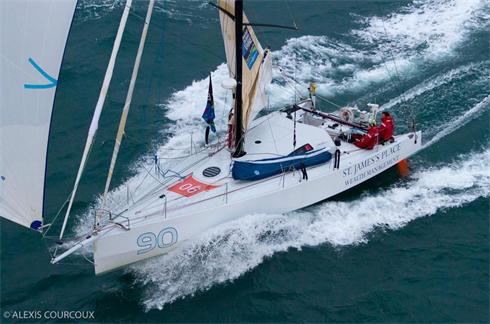


Class 40 sailboat design - it's become released with the expectation of which we will stimulate useful to you actually. The next few paragraphs might offer for a a blueprint while you're lost to choose the ideal instruction This Class 40 sailboat design content articles may just be your own preference to become put on the job strategy, since it offers its strategy may really feel much more happy Class 40 sailboat design - Extremely helpful for yourself thus most of us looking to uncover a reliable form which inturn will help uou see drive free of indecision. do not forget to bookmark this page, for the reason that might be sooner or later you need them backside mainly because an individual's inspirational recommendations.
Abonnieren
Posts (Atom)


